How to record oral history with consent: a 7-step protocol for an elder’s songs and stories
To record oral history with consent, agree first with the community on who decides, document informed consent that can be withdrawn, record in an archival format (WAV or BWF, at least 48 kHz and 24-bit), write the metadata and provenance on the day, keep the files where the community controls access, use AI tools only with separate consent and human review, and return a full copy to the community. The seven steps below follow the CARE Principles, OCAP® and the Oral History Association’s best practices, with a source for every rule.
Before the recorder is on: who decides
The decision to record an elder belongs to the knowledge holder and to the community whose protocols govern the song or story. General principles yield to those protocols: the 2026 publishing guidelines built on CARE state that deference should be given to Indigenous Peoples and communities with more specific protocols and requirements.
Some material carries conditions that a recordist from outside may miss. The Local Contexts Traditional Knowledge Labels exist to express them, including TK Seasonal, TK Women Restricted, TK Secret/Sacred and TK Community Voice. Before the first session, settle these points with the right people, who may be a council, a cultural officer, the family or a Knowledge Keeper:
Authority
Who can say yes for this material, and whose agreement is also needed.
Scope
What may be recorded, and what stays unrecorded or stays within the family or community.
Audience
Who may hear or see the recording, and whether conditions depend on season, gender or ceremony.
The plan for afterwards
The Oral History Association advises that the care and access plan for a recording be mapped out before a narrator is approached.
A community that wants its songs and stories held under its own authority can claim its page on FirstCiv. A person verifies every claim by direct contact.
Claim stewardship for your community →Consent that can be withdrawn: what to document
Informed consent means documenting the knowing agreement of the narrator to take part, before the interview begins. The Oral History Association recommends a written record with signatures; where time, language or literacy make that unworkable, it recommends recording the explanation of goals and risks and the narrator’s consent at the start of the recording itself.
Consent also needs a way back. The same guidance lists the narrator’s options: delete, restrict or redact portions, add clarifications, keep the interview closed until a set date, or decline public release. It is also candid that material already public may be impossible to remove fully, so the recordist should say by what date withdrawal becomes difficult. The OHA’s Social Justice Task Force recommends “rolling consent”: permission is reconfirmed or changed over time at the narrator’s request. The table shows what an oral history consent form should capture.
| Field | What to write down | Basis |
|---|---|---|
| Who agreed | Name, role and community of the knowledge holder and of any community representative | OHA informed consent; CARE Authority to Control |
| Naming and credit | Whether the person and the community may be named, and how to spell names with diacritics | 2026 CARE publishing guidelines: naming only with consent |
| Permitted uses | A separate yes or no for public display, research, teaching and AI processing | OHA legal release options; CARE Ethics |
| Who may access it | Open, community-only, or restricted by season, gender or ceremony | Local Contexts TK Labels; OCAP® Access |
| Licence | Community-restricted, or a Creative Commons licence if the community wants one | OHA glossary terms: Creative Commons, public domain |
| Review and withdrawal | How the narrator reviews before release, how to withdraw, and the date after which removal becomes difficult | OHA narrator review and withdrawal |
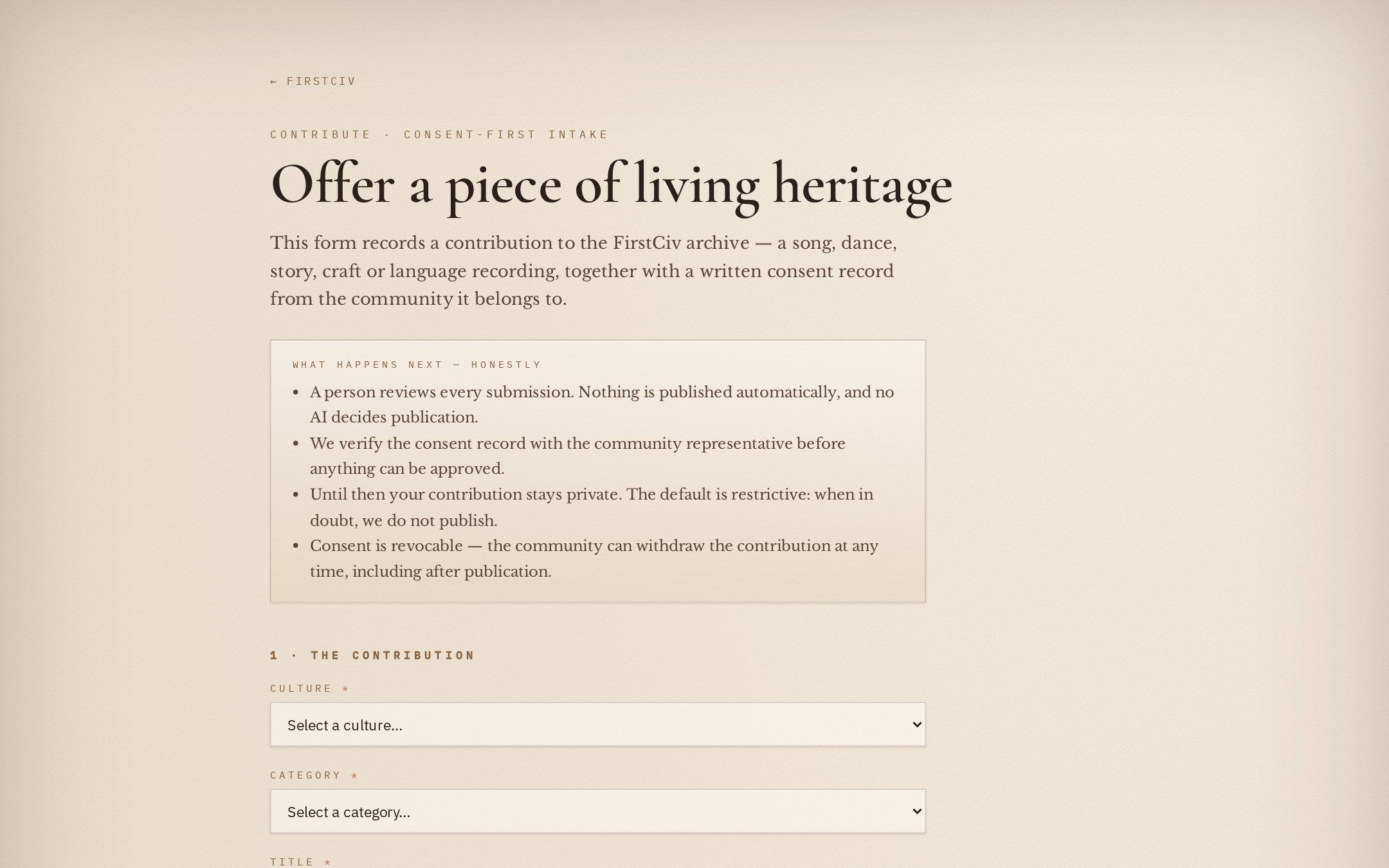
The FirstCiv contribution form records these same choices: four separate permitted uses, a community-restricted licence as the default, collaborators to credit and a community representative whose consent record is verified before anything is approved.
Recording: sound, video and context
An archival field recording is uncompressed audio in a standard linear format, normally WAV or Broadcast WAV (BWF), at 48 kHz or higher and 24-bit. That is the recommendation of the International Association of Sound and Audiovisual Archives in its guideline TC-04, section 5.7.2.
Format
Record natively to WAV or BWF. IASA warns that MP3 and similar data-reduced formats produce recordings that do not meet archival standards, because the lost data cannot be recovered later.
Levels
Set the level by hand on the voice or instrument. IASA advises against automatic gain control because it raises background noise and flattens the original dynamics.
Context on tape
With consent, open the file with the date, place and the names the narrator agreed to. If consent was given orally, it belongs at the start of this recording.
File size
A 48 kHz, 24-bit stereo WAV takes about 17 MB per minute, mono about 8.6 MB. The FirstCiv upload limit is 200 MB per file, roughly 12 minutes of stereo or 24 of mono; keep the full master with the community.
Metadata and provenance: how to archive field recordings
Metadata is the written record that lets a future listener know who was recorded, when, where, by whom and on what terms. The Oral History Association groups it into administrative, descriptive, technical, preservation, and rights and access information, and notes that it may need updating after the interview.
Write it on the day, while the people who know the answers are in the room. IASA recommends Unicode and XML for field metadata until a shared standard exists, and notes that BWF carries critical metadata inside the audio file. The 2026 CARE publishing guidelines add three provenance practices: cite the IEEE Recommended Practice for the Provenance of Indigenous Peoples’ Data, carry Local Contexts Labels next to any Creative Commons licence, and use persistent identifiers that link outputs back to places and communities.
- Descriptive
- Title in the community’s language and in English, genre, occasion, performers and their communities.
- Rights
- The consent record from step 2, the licence and any access condition or label.
- Technical
- Recorder, microphone, format, sample rate, bit depth, file checksums.
- Provenance
- Who recorded it, who holds the master, and every later decision about it.
On FirstCiv, each item carries its source and consent basis, and every moderation decision is written to a public tamper-evident ledger described on the governance page.
Where to keep it and who controls access: CARE and OCAP®
A community-owned archive is one where the community decides who sees each recording and can take it back. Two frameworks define that control. The CARE Principles, released in September 2019, hosted by the Global Indigenous Data Alliance and described in the Data Science Journal in 2020, apply to Indigenous data worldwide. OCAP®, from the First Nations Information Governance Centre, sets out how First Nations’ data is collected, protected, used and shared.
- CARE: Collective Benefit
- Data must enable inclusive development, better governance and equitable outcomes for Indigenous Peoples.
- CARE: Authority to Control
- Indigenous Peoples determine data governance protocols and have access to data that supports self-determination.
- CARE: Responsibility
- Those who work with the data nurture respectful relationships with the people it comes from.
- CARE: Ethics
- Rights and wellbeing come first across the data lifecycle, to minimise harm and allow for future use.
- OCAP®: Ownership
- A community owns its information collectively, as a person owns personal information.
- OCAP®: Control
- First Nations have the right to seek control over every stage of research and information management that affects them.
- OCAP®: Access
- Communities have access to data about themselves wherever it is held, and decide who else gets access.
- OCAP®: Possession
- Physical control of the data, the mechanism by which ownership is protected.
In practice: keep the master copy on storage the community controls, and give any platform a copy under documented consent. FirstCiv’s data sovereignty policy says openly that a hosted platform does not give a community physical possession, and describes what it does today: private storage by default, media served only while consent covers public display, and withdrawal that stops the media being served. OCAP® is a registered trademark of the First Nations Information Governance Centre; FirstCiv is independent of FNIGC and carries no FNIGC endorsement.
Using AI tools: only with explicit consent and human review
AI transcription and translation belong in the consent record as a separate permission, and every draft needs review by a person who speaks the language. The 2026 CARE publishing guidelines ask for a fluent translator to validate any translation made with a public LLM, and advise against using AI as a first-pass check.
Ask separately
Consent to publish and consent to AI processing are two different answers.
Read the tool’s terms
Check whether the provider keeps uploads or trains on them, and tell the community before any file leaves your hands.
Treat output as a draft
A fluent speaker corrects it; the community decides whether it is shown.
On FirstCiv, material enters an AI tool only with the separate AI-processing consent, and contributed material is never used to train AI models. The optional draft assistant is dormant today: no AI provider is configured, so moderation is entirely human.
Giving the recording back to the community
Giving a recording back means the community receives the full master, the metadata and the consent terms, free of charge, and is told about every later use. OCAP® Access holds that communities must have access to data about themselves regardless of where it is held; the CARE publishing guidelines ask for free access to publications for the communities concerned and for revised manuscripts to be shared with community partners.
Masters and metadata
Hand over the WAV or BWF files and the metadata sheet, in a form the community can open without special software.
The consent terms
The OHA advises that the narrator receives a copy of the legal release terms.
Every output
Articles, transcripts and exhibitions made from the recording, with links back to the originals.
On FirstCiv, a community can ask for everything held about it through the contact page, and a person replies. A self-serve export is planned. Explore the 22 reference culture editions in the Living Atlas; each is open for its community to claim, correct or remove.
Questions about recording oral history with consent
- How do you record oral history with consent?
- Agree with the community on who decides, explain the goals and risks, document informed consent in writing or at the start of the recording, record in WAV or BWF at 48 kHz and 24-bit, and give the narrator a way to review and withdraw.
- What should an oral history consent form include?
- Who agreed and on whose behalf, whether names may be used, separate permission for display, research, teaching and AI, access conditions, the licence, and how and until when consent can be withdrawn.
- Can an elder withdraw consent after the recording?
- Yes. The Oral History Association recognises the right to restrict, change or withdraw an interview, and advises stating the date after which full removal becomes difficult. On FirstCiv, withdrawal unpublishes the item and stops its media being served.
- What audio format is best for archiving field recordings?
- IASA TC-04 recommends uncompressed WAV or Broadcast WAV at a minimum of 48 kHz, recorded at 24-bit. MP3 and other data-reduced formats fall below archival standards.
- What is a community-owned archive?
- An archive where the originating community decides who may see each item, can correct or withdraw it, and holds or can obtain the full record, in line with CARE and OCAP®.
Offer a recording, on your community’s terms
Choose who may see it and which uses are allowed. A person reviews it before anything is published, and consent stays revocable. Funders can see where the project stands on the funders page.
Sources
Oral History Association, Principles and Best Practices (2025 edition)
IASA TC-04, 5.7.2 Field Recording Standards · 5.7.4 Approach to recording · 5.7.7 Metadata and Field Tools
Carroll et al., The CARE Principles for Indigenous Data Governance, Data Science Journal (2020)
First Nations Information Governance Centre, The First Nations Principles of OCAP®
Local Contexts, Traditional Knowledge Labels
Guidelines for the Governance of Indigenous Peoples’ Data in Scholarly Publishing (2026) · our news note: what the guidelines change