
A people of the high forest
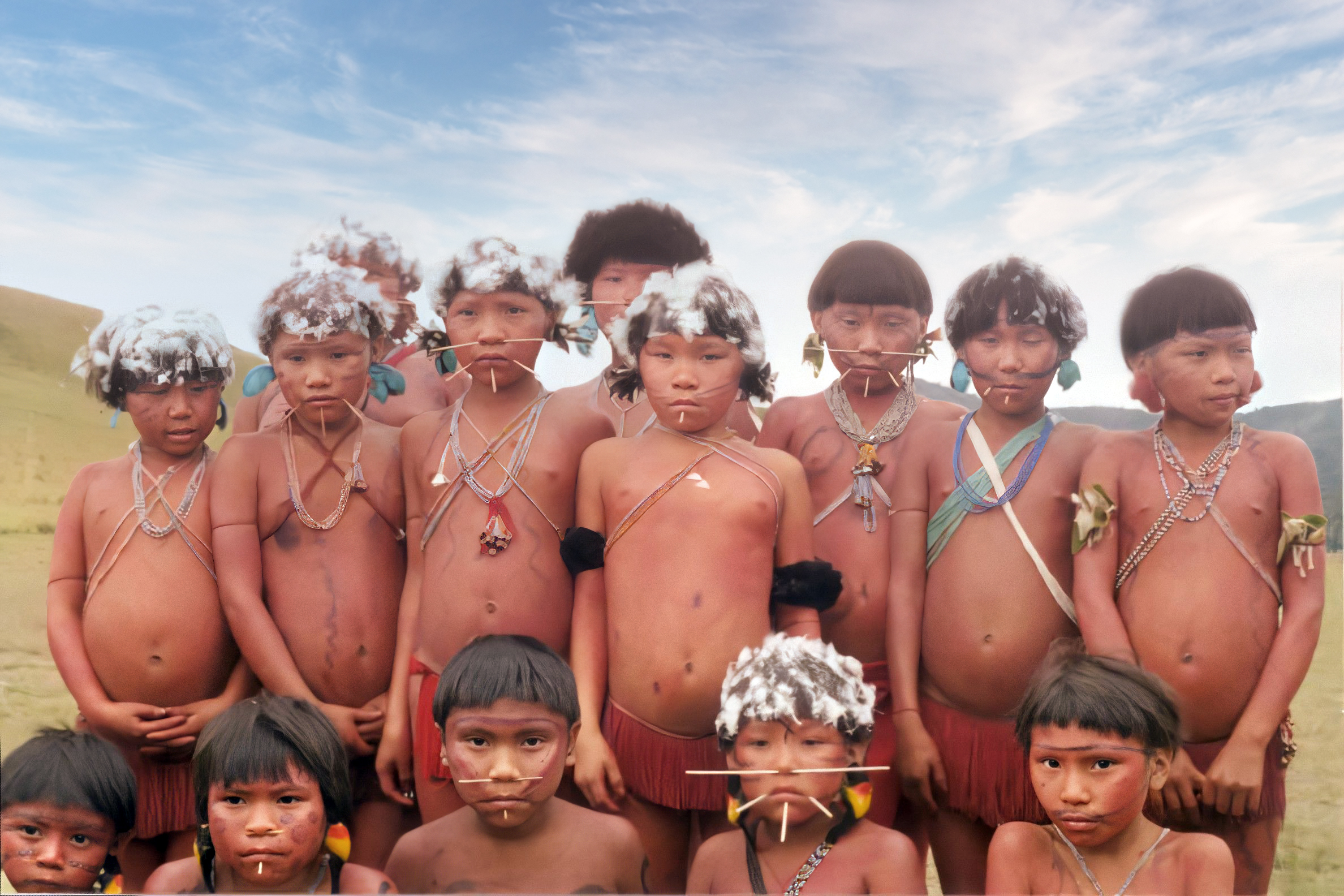

The Yanomami live in the rainforest highlands that straddle the frontier of northern Brazil and southern Venezuela — a homeland of perhaps nine and a half million hectares, among the largest forest territories held by any Indigenous people in the Americas. They are not a single village but hundreds of largely autonomous communities, linked by marriage, trade, feasting and a shared world of the spirit, who reached sustained contact with the outside world only in the twentieth century. They speak a family of four related languages and remain, today, one of the most populous relatively isolated peoples of the Amazon.
The shabono and the gardens
Each community lives in a shabono: a great ring of lean-to roofs, open to the sky at the centre, where every family keeps its own hearth and hammock around one shared clearing. Life turns on the slash-and-burn garden — plantain, manioc, sweet potato and tobacco — worked until the soil tires, after which the community moves and lets the forest grow back. Men hunt tapir, peccary and monkey with bow and curare-tipped arrow; women gather, fish with timbó vine, and tend the garden. The forest is not a resource to be spent but a living web to be kept in balance.

The falling sky, and the fight for the forest
From the 1970s a road, missions and then a gold rush tore into Yanomami land; in the worst years of the 1980s an estimated fifth of the Brazilian Yanomami died of introduced disease and violence. A long campaign led by the shaman Davi Kopenawa and Hutukara, the Yanomami association, won a demarcated territory in 1992. Yet illegal miners — the garimpeiros — have returned in their thousands, poisoning rivers with mercury and bringing malaria and hunger; a humanitarian emergency was declared in 2023. The Yanomami's defence of their forest is also, as Kopenawa insists, a defence of the whole world's sky.
What is kept alive


.jpg)

A long thread
Hear it for yourself

Threads across the graph
Quechua
Fellow heirs of the Amazon and Andes whose knowledge of the living land is carried in voice and craft rather than writing.
Aboriginal Australians
First Peoples whose relationship to Country, like urihi, makes land kin and law rather than property.
San
Another ancient people whose shamans enter trance to heal and to travel between the seen and unseen worlds.
Common questions
Who are the Yanomami?
The Yanomami are an Indigenous forest people of the Amazon, living in some hundreds of communities across the highlands where northern Brazil meets southern Venezuela. Numbering around 38,000, they are one of the largest relatively isolated peoples in the Americas, dwelling in communal ring-houses called shabono and reaching sustained contact with the outside world only in the twentieth century.
What language do the Yanomami speak?
They speak a family of four closely related languages — Yanomam, Yanam, Sanöma and Yanomami proper — which together form the Yanomaman family, an isolate with no proven link to other language groups. It remains an oral language family; it has been written in the Latin alphabet only since the late twentieth century, for schools and books.
What is a shabono, and how do the Yanomami live?
A shabono is a single large circular dwelling — a continuous ring of palm-thatched lean-tos open to the sky at the centre, where each family keeps its own hearth and hammock around one shared clearing. Communities live by slash-and-burn gardening, hunting with bow and curare-tipped arrow, fishing and gathering, moving the village every few years as the soil and forest are allowed to recover.
What is the role of shamans and the xapiri?
Shamans, or shapori, inhale the visionary snuff yãkoana to call down the xapiri — luminous spirit-images of the animals and forces of the forest. Through chant the xapiri come to dance, to heal the sick and, in Yanomami belief, to hold up the sky itself. The reahu funerary feast, which lays the dead to rest and binds allied communities, is the other great pillar of their spiritual life.
What threatens the Yanomami, and how can their heritage be preserved?
Illegal gold-mining is the gravest threat: thousands of miners have poisoned rivers with mercury and spread malaria and hunger, leading Brazil to declare a humanitarian emergency in 2023. Their heritage is best preserved by supporting Yanomami-led organisations such as Hutukara, defending the demarcated territory, and recording their songs, language and knowledge only with consent and community ownership — so the value, and the final say, stay with the people themselves.
The recordings on this page are openly-licensed reference material, credited to their sources. The Yanomami are named as origin; if this heritage is yours, you can claim this page, correct it, or ask for anything to be removed. Photographs: Wikimedia Commons (CC0 / public domain / CC BY / CC BY-SA).