
Athabaskan travellers of the Southwest
The Diné are not ancient to the Southwest in the way their Pueblo neighbours are. Their language is Athabaskan, kin to the tongues of the far Canadian and Alaskan north, and their ancestors travelled south to arrive in the Four Corners country only some five or six centuries ago. There they made the land their own — taking up farming, and later the sheep and horses brought by the Spanish — and bounded their world with four sacred mountains, one for each direction, within which to walk in hózhó.
.jpg)
The loom, the forge and the land
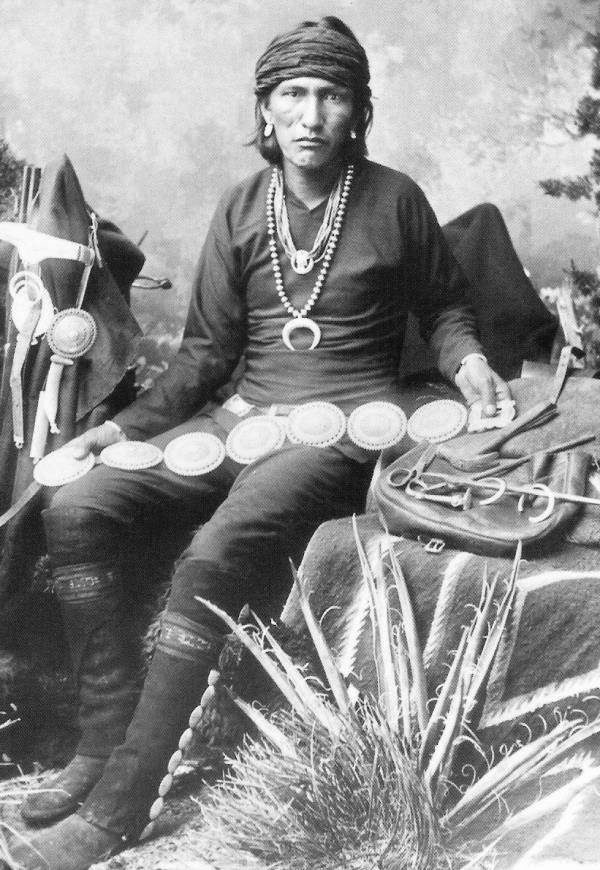
From their Pueblo neighbours the Diné learned to weave, and from Mexican smiths in the 1850s to work silver — and they carried both crafts past their teachers. A Navajo rug is built upright, band by band, in patterns named for the places that made them: Ganado red, the natural greys of Two Grey Hills, the lightning of the Storm pattern. Turquoise, the sky-stone, set in heavy silver, became the squash-blossom necklace and the concho belt the world now knows. Both crafts are a way of putting beauty back into the world.

The Long Walk, the Code, and a nation today
In 1864 the US Army forced thousands of Diné on the Long Walk to imprisonment at Bosque Redondo; four years later a treaty let the survivors return to a portion of their homeland — a rare homecoming in that history. In the Second World War, Diné Marines turned their unwritten, tonal language into a battlefield code the enemy never broke. Today the Navajo Nation is the largest reservation in the country, self-governing from Window Rock, its weavers, smiths, singers and language-keepers carrying hózhó firmly into the present.

What is kept alive



A long thread
Hear it for yourself


Threads across the graph
Quechua
Andean master weavers whose textiles, like Diné rugs, carry land and cosmology in their bands.
Inuit
Distant Na-Dené kin's Arctic neighbours — Indigenous custodians whose carving and song hold the knowledge of a hard homeland.
Aboriginal Australians
First Peoples who, like the Diné, keep sacred knowledge restricted and map their Country in story and design.
Common questions
Who are the Diné (Navajo)?
The Diné — called Navajo by outsiders — are the largest Native American nation in the United States, with around 400,000 enrolled members. Their homeland, Diné Bikéyah, spans high desert and red-rock canyon across Arizona, New Mexico and Utah, bounded by four sacred mountains. Diné means simply 'the People' in their own language.
What language do the Navajo speak?
They speak Diné bizaad, an Athabaskan (Na-Dené) language related to tongues of northern Canada and Alaska. It is tonal and verb-rich, with four tones marked by accents — a subtlety that made it, unwritten, an unbreakable code used by Diné Marines in the Second World War. It remains one of the most widely spoken Native languages in the US, though fewer children now learn it first.
What does hózhó mean?
Hózhó is the central idea of Diné life — a state of beauty, harmony and balance between a person and the world. The great healing ceremonies, the Chantways, are sung by a hataałii (medicine person) to restore hózhó when illness or hardship has disturbed it. The aim, in the closing prayer, is to 'walk in beauty' in every direction.
What crafts are the Navajo known for?
The Diné are renowned for weaving — upright-loom rugs whose patterns, such as Ganado red and Two Grey Hills, name the place and family that made them — and for silver-and-turquoise smithing, including the squash-blossom necklace and the concho belt. They live around the hogan, a round earth-and-timber dwelling whose door faces the rising sun.
How can I help preserve Diné culture?
Support it on the People's own terms: buy weaving and silverwork directly from Diné artists rather than imitations, back Diné bizaad immersion schools and language programmes, and respect that ceremonies and sandpaintings are sacred and not for public sale. On FirstCiv, collecting a Navajo Heritage Tablet returns the majority of its value to the community of origin, who keep ownership and the final say.
The recordings on this page are openly-licensed reference material, credited to their sources. The Diné (Navajo) are named as origin; if this heritage is yours, you can claim this page, correct it, or ask for anything to be removed. Photographs & media: Wikimedia Commons (CC0 / public domain / CC BY / CC BY-SA).