
A people of the high ridges
The Hmong are one branch of the Miao peoples of southern China, with a homeland in the cloud-wrapped uplands of Guizhou, Yunnan and Sichuan reaching back thousands of years. Pressed by expanding empires, waves of Hmong migrated south from the early 1800s into the mountains of Vietnam, Laos and Thailand, always settling the steep high ground above their lowland neighbours — clearing terraces, growing rice, maize and once the poppy, and keeping their language and clan law intact across every border they crossed.

The cloth that remembers
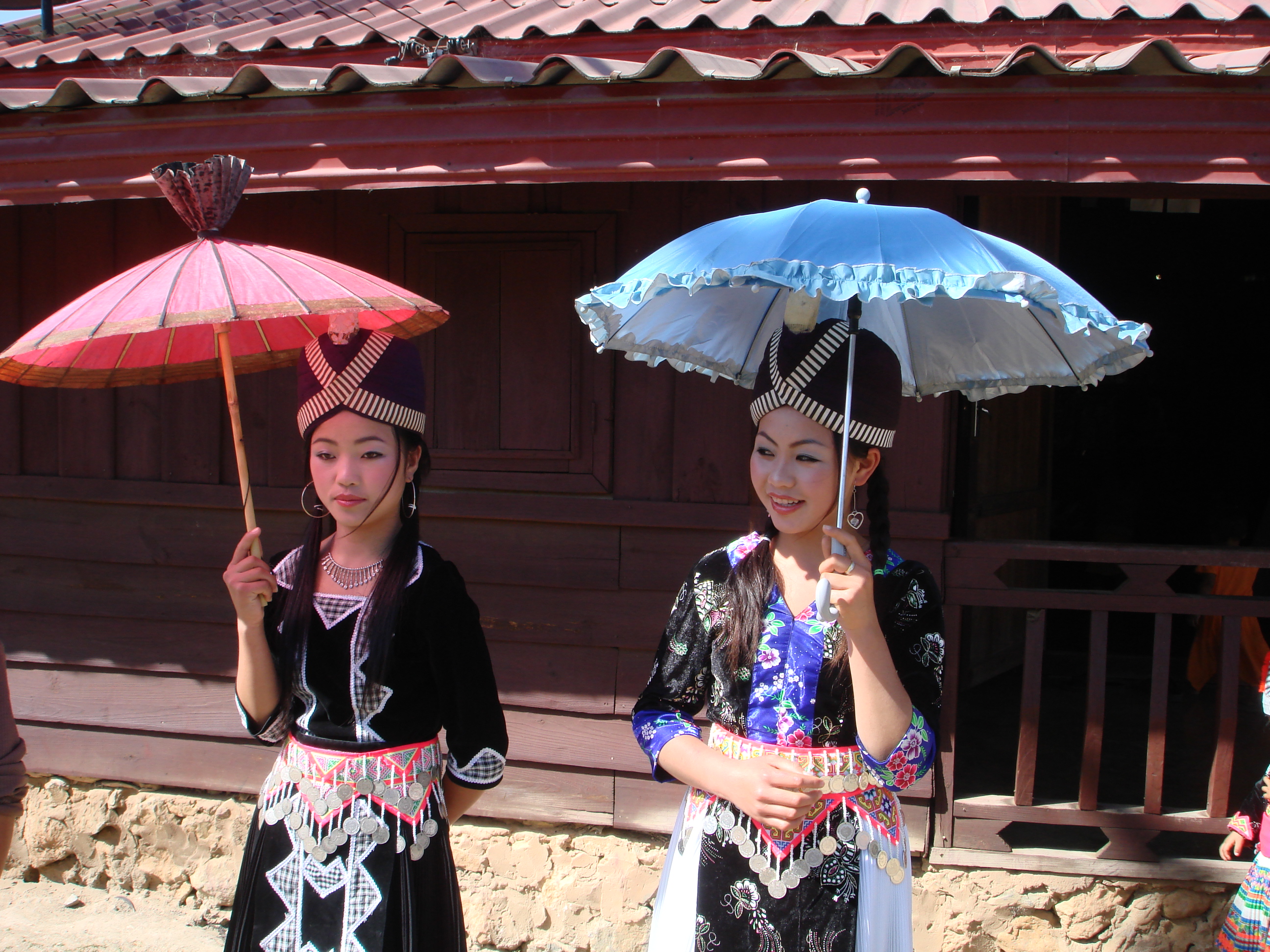
Because the Hmong long had no script, memory was given to the needle. Paj ntaub — flower cloth — is built from reverse appliqué, cross-stitch and batik into snail-shells, ram's-horns, elephant-feet and seeds, each motif a name and a blessing, each region and sub-group with its own unmistakable hand. From this older art, women in the refugee camps of the 1970s created the story-cloth: figurative panels that narrate the flight from Laos, the crossing of the Mekong and the journey into exile — history sewn down where it could not be written.
_-_Vietnam_Museum_of_Ethnology_-_Hanoi%2C_Vietnam_-_DSC03046.JPG)
War, exile and a living present
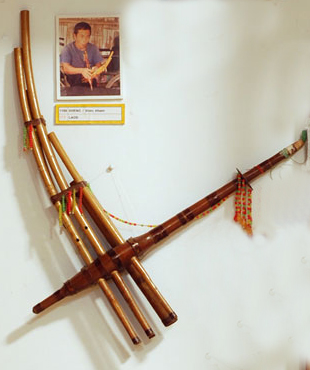
During the wars in Indochina many Hmong in Laos were recruited into a 'Secret War' alongside foreign forces; when it ended in 1975 tens of thousands fled persecution across the Mekong into Thai camps, and from there resettled in the United States, France, Australia and beyond. Today the Hmong are at once a highland people of Asia and a confident diaspora — holding New Year festivals from Fresno to Minnesota, raising a generation of writers, scholars and artists, and carrying the qeej, the paj ntaub and the courtship song into a wholly new world.

What is kept alive
_-_Vietnam_Museum_of_Ethnology_-_Hanoi%2C_Vietnam_-_DSC03073.JPG)
_-_Vietnam_Museum_of_Ethnology_-_Hanoi%2C_Vietnam_-_DSC03036.JPG)


A long thread
Hear it for yourself

Threads across the graph
Tibetan
Highland neighbours of the eastern ranges whose ritual life, like the qeej's, opens a road between the living and the dead.
Quechua
Mountain people who, like the Hmong, write their history and cosmology into woven and stitched cloth rather than onto the page.
Diné (Navajo)
A people whose textiles and chant carry sacred order — and who, like the Hmong, have remade their culture far from the first homeland.
Common questions
Who are the Hmong?
The Hmong are a highland people, one branch of the Miao of southern China, with communities across the mountains of China, Vietnam, Laos and Thailand and a large diaspora in the United States, France and Australia. They organise themselves by some eighteen patrilineal clans rather than by nation, and are known for paj ntaub embroidery, the qeej reed-pipes and improvised courtship song.
What is paj ntaub?
Paj ntaub — literally 'flower cloth' — is the Hmong textile art of reverse appliqué, cross-stitch and indigo batik, worked in dense geometric motifs whose patterns name a region, a sub-group and a blessing. From it grew the story-cloth, a figurative panel that narrates the Hmong flight from Laos and the journey into exile — a way of writing history in thread for a people who long had no script.
Do the Hmong have a written language?
For most of their history they did not, and folk tales explain the loss in different ways. In 1959 Shong Lue Yang invented Pahawh Hmong, an original syllabic script — one of very few created from scratch in modern times. Today most Hmong write with the Romanised Popular Alphabet (RPA), in which final consonants mark the language's eight tones, while Pahawh is still taught and honoured.
Where do the Hmong live today?
The largest populations remain in southern China and in the highlands of Vietnam, Laos and Thailand. Since the wars of the 1970s a substantial diaspora has settled in the United States — especially Minnesota, California and Wisconsin — as well as in France, French Guiana and Australia, where Hmong New Year festivals keep the culture alive far from the first homeland.
How can the Hmong heritage be helped to survive?
By recording and sharing it with consent and with credit and benefit flowing back to the community. On FirstCiv, songs, crafts and spoken Hmong are documented with first-language speakers and makers, minted as community-owned Heritage Tablets, and kept on an open ledger so the clans of origin are named as owners — supporting the language nests, New Year festivals and craft cooperatives that pass the tradition to the young.
The recordings on this page are openly-licensed reference material, credited to their sources. The Hmong are named as origin; if this heritage is yours, you can claim this page, correct it, or ask for anything to be removed. Photographs & textiles: Wikimedia Commons (CC0 / public domain / CC BY / CC BY-SA).