
The people who held the frontier
Alone among the peoples of the southern Andes, the Mapuche turned back both the Inca and the Spanish. At the Battle of the Maule the Inca advance was checked; from 1536 the Mapuche fought the Spanish to a standstill, and after the great rising led by Lautaro the Crown was forced to recognise the Biobío river as a true border. For nearly three hundred years Wallmapu — the land — remained independent, governed by its own lof communities and their lonko, a freedom almost unmatched in the Americas.
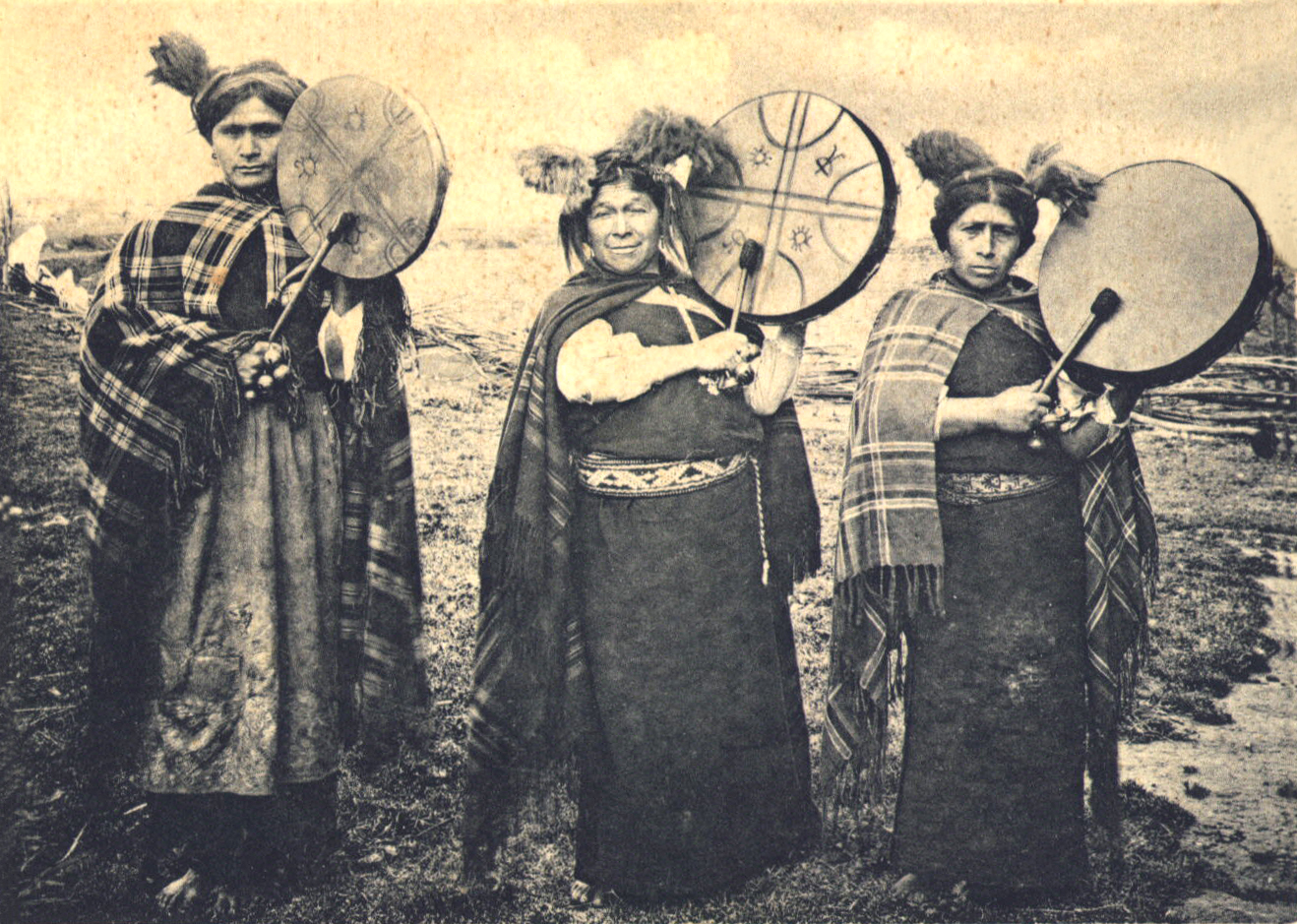
A cloth, a drum and a working of silver
Mapuche knowledge is held in things made by hand. On the upright witral loom a weaver builds ñimin — figured bands of the stepped lukutuwe cross, of paths, water and stars — so that a poncho or a manta can be read like a record of place and lineage. The shallow kultrún drum, its skin painted with the four quarters of the world, and the long trutruca horn carry the ülkantun songs. And in silver the retrafe smiths once hammered melted coins into the trapelakucha and the trarilonko headband, ornaments that name a woman's family and gather mana as they pass down.

Occupation, loss and a living present
In the 1880s the Chilean and Argentine states broke the frontier by force — the 'Pacification of Araucanía' and the 'Conquest of the Desert' — seizing the land and pressing the Mapuche onto reducciones. Mapudungun was punished in schools and the old life pushed to the margins. Yet the culture endured. Today poets like Elicura Chihuailaf and Leonel Lienlaf write in Mapudungun, language nests and bilingual schools teach a new generation, and the weaving, silverwork and song continue — a people speaking firmly in the present tense, and still pressing their claim to the land.

What is kept alive


A long thread
Hear it for yourself
.jpg)
Threads across the graph
Quechua
Andean neighbours whose woven cloth, like Mapuche ñimin, reads as genealogy and place made visible.
Yanomami
Another South American people whose knowledge lives in voice and a living, spirited forest rather than in writing.
Diné (Navajo)
Master weavers and silversmiths whose textiles and silver, like the Mapuche loom and trapelakucha, carry cosmology and balance.
Common questions
Who are the Mapuche?
The Mapuche are the Indigenous people of south-central Chile and the Andean steppe of Argentina — 'che' (people) of the 'mapu' (land). They are the largest Indigenous group in Chile and famously resisted both the Inca and Spanish empires for centuries.
What language do the Mapuche speak?
They speak Mapudungun, 'the speech of the land', an Araucanian language spoken across Chile and Argentina. It is endangered but being revitalised through language nests and bilingual schools, and is written today in the Latin alphabet.
What is the kultrún?
The kultrún is a shallow ceremonial drum whose painted skin maps the four quarters of the Mapuche world. It carries ülkantun song and is central to gatherings — one of the most recognisable Mapuche instruments alongside the long trutruca horn.
What is Mapuche silverwork?
Mapuche rütran is a renowned silversmithing tradition. The retrafe smiths craft pieces such as the trapelakucha (a pectoral worn at the breast) and the trarilonko (headband), which name a woman's lineage and gather mana as they pass down the generations.
How can I support Mapuche heritage respectfully?
Follow Mapuche-led organisations and communities, learn from their voices directly, never seek out sacred or ceremonial material, and ensure any recording is made with consent and returns value to the community — the principle behind FirstCiv's Heritage Tablets.
The recordings on this page are openly-licensed reference material, credited to their sources. The Mapuche are named as origin; if this heritage is yours, you can claim this page, correct it, or ask for anything to be removed. Photographs & media: Wikimedia Commons (public domain / CC BY / CC BY-SA) — historic portraits from Araucanía, 1890–1920s.